All blog
Suspensions
Dec 25, 2025
6 Min read

Account Suspension
Amazon Seller Account Suspended Counterfeit (Frozen Inventory)
With Amazon facing a $30 million lawsuit, sellers are in the spotlight. Discover why protecting your account and inventory is more critical than ever.
TL;DR
An Amazon seller account suspended for counterfeit is a Section 3 enforcement action where Amazon assumes product inauthenticity until proven otherwise. Even genuine products can trigger this suspension if invoices, warranties, or the chain of custody cannot be verified. The result is immediate account deactivation, frozen funds, and inventory at risk of destruction—making documentation accuracy the deciding factor in reinstatement.
Introduction: Why “Counterfeit” Is Amazon’s Most Dangerous Suspension
It’s 6:15 AM. Mike, a wholesale reseller, opens his phone to check his overnight sales. Instead of the usual dashboard, he sees the notification every seller fears: “Your Amazon.com selling privileges have been removed.”
By 6:30 AM, he realizes the severity of the situation. His $45,000 disbursement scheduled for tomorrow is frozen. His FBA inventory—thousands of units sitting in Amazon warehouses—is now trapped, with a looming threat of disposal. He isn't dealing with a simple operational glitch; he is dealing with an Amazon seller account suspended for Counterfeit, the single most aggressive suspension type in the Amazon ecosystem.
This is the reality of the "Guilty Until Proven Innocent" algorithm. In the United States, Amazon is under immense legal pressure to prevent counterfeit goods from entering the market. To protect themselves, they have tuned their bots to be ruthless. If a customer complaint, a competitor attack, or a random keyword scan triggers an Amazon account suspended counterfeit flag, Amazon does not ask for proof first—they evict you immediately.
Because these decisions are algorithm-driven, some sellers use monitoring tools like ave7LIFT to track Voice of Customer trends and policy risk indicators before they escalate into Section 3 enforcement.
The "Death Sentence" of Amazon Accounts: Section 3
Most suspensions are like traffic tickets. If your Late Shipment Rate rises, you get a warning. If your Order Defect Rate (ODR) hits 1.5%, you get a suspension, but Amazon tells you exactly how to fix it.
A Counterfeit suspension is different. It triggers Section 3 of the Amazon Business Solutions Agreement (BSA).
Under Section 3, Amazon reserves the right to suspend Amazon seller account privileges immediately if it suspects "deceptive, fraudulent, or illegal activity." Unlike performance suspension, where Amazon wants you to improve, a Section 3 suspension means Amazon believes you are a bad actor. They view your business as a legal liability.
The Risk: It is not just about losing sales for a week. It is about having your Amazon seller account banned permanently, the holding of your funds, and the destruction of your inventory.
The Challenge: You cannot simply say, "I didn't do it." You must provide a specific, legal chain of custody that satisfies an internal investigator who is looking for a reason to reject you.
If you are currently in Mike's position—staring at a frozen account and wondering how to prove the authenticity of products you know are real—you need to stop, breathe, and put away the "Appeal" button for a moment. Rushing a generic response now can seal your fate.
If you’re unsure whether your account is suspended, denied, or permanently closed, read our Amazon Seller Account Suspended: Ultimate Reinstatement Guide, which explains each status and the correct recovery strategy.

1. What Does “Counterfeit” Mean Under Amazon Policy?
Mike’s first reaction to the suspension email was righteous indignation. "These aren't fake," he told his warehouse manager. "I have the invoices right here from a legitimate distributor in Ohio. These are genuine products."
He was right—they were genuine. But he was making a fatal error: assuming Amazon uses the dictionary definition of "Counterfeit."
In the real world, "Counterfeit" means a fake product meant to deceive (like a knock-off Rolex sold in a back alley). In Amazon’s world, "Counterfeit" is a catch-all term for any product where the Chain of Custody cannot be perfectly verified, or where the condition does not match the strict "New" guidelines.
Amazon’s Definition vs. The Legal Definition
Amazon operates on a "Zero Tolerance" policy. To protect themselves from lawsuits, they cast a wide net. If their AI detects even a slight discrepancy, they default to the worst-case scenario.
Mike discovered that while his product was authentic manufacturing-wise, he had an Amazon seller account suspended inauthentic status based on policy violations.
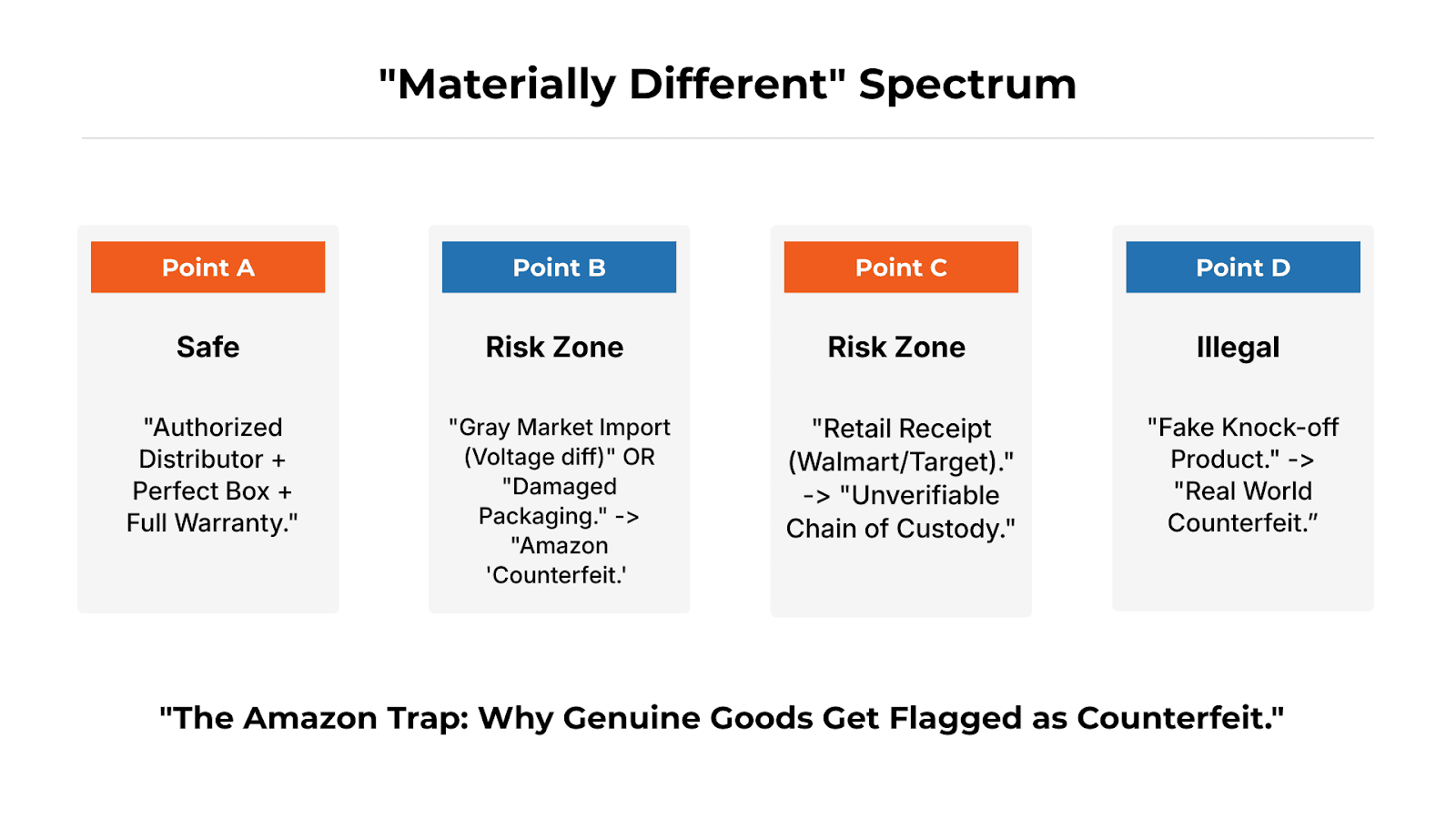
What Does "Materially Different" Mean?
This is the trap that catches 90% of honest sellers like Mike. Under US law (and Amazon policy), a genuine product can be considered "Counterfeit" if it is Materially Different from what the manufacturer intends for that specific marketplace.
The Warranty Trap: If Mike sells a vacuum cleaner as "New," the customer expects the full manufacturer’s warranty. However, if Mike’s distributor isn't on the manufacturer’s "Authorized" list, the warranty might not transfer to the final customer. To Amazon, a product without a warranty sold as "New" is materially different from the genuine article. Therefore, it is "Counterfeit."
Gray Market Goods: If Mike bought stock intended for the European market and sold it on Amazon.com, the plug or voltage might be different. Even if it’s made by the same factory, it is "Materially Different."
Counterfeit Suspension vs. Intellectual Property (IP) Complaints
It is critical to know who shot you.
IP Complaints: This comes from the Brand Owner (e.g., Nike files a complaint saying you aren't authorized).
Counterfeit/Inauthentic Suspensions: This often comes from Amazon’s own bots or customer feedback, leading to an Amazon account suspended inauthentic notification.
Mike wasn't sued by the brand; he was flagged by Amazon because a customer complained the item "looked used." Amazon’s system translated "looked used" into "Inauthentic/Counterfeit."
2. Common Reasons Amazon Flags Sellers for Counterfeit (USA)
How did Amazon find Mike? He processes thousands of orders a month. Why this ASIN? Why now?
The Usual Suspects
Customer Complaints: A buyer writes a review saying, "This looks fake," or returns an item, choosing the reason "Not legitimate." Amazon’s bots scrape these keywords instantly.
A-to-Z Claims: If a customer claims an item didn't arrive or wasn't as described, and uses trigger words like "fake" or "knockoff" to ensure they get a refund, it triggers a Section 3 investigation.
Weaponized False Claims
Mike later suspected he was a victim of a "Black Hat" attack. In competitive categories, unscrupulous sellers will hire third parties to buy a competitor's product and immediately report it as counterfeit. It is a "Guilty until Proven Innocent" system, and bad actors know how to pull the trigger.
The "Item Not as Described" Trigger
Sometimes, it’s purely algorithmic. If a manufacturer updates their packaging (e.g., changes a blue box to a red box) but the Amazon listing photo still shows the blue box, customers will complain they received the wrong item. Amazon’s AI interprets these "Not as Described" complaints as evidence of counterfeiting.
This is where ave7LIFT shines. Our system monitors Voice of Customer (NCX) data 24/7. If we detect a spike in negative phrases like "fake" or "used," we alert you before the suspension hits, allowing you to close the listing and investigate before Amazon locks your entire account. Book your 30-day free trial with ave7LIFT.

3. Immediate Consequences: What Happens After a Counterfeit Suspension?
By 8:00 AM, the reality of the "Death Sentence" had set in for Mike. He tried to navigate to his "Manage Inventory" screen to recall his stock, thinking he would just sell the goods on eBay to recoup his cash.
He found the buttons grayed out.
Account and ASIN Deactivation
When Section 3 hits, it’s a hard stop. All active listings are pulled. Your storefront becomes a ghost town. But that isn't the worst part.
The Freeze on Removal Orders
This is the shock that panics most sellers. Amazon will not let you remove your inventory. Under federal anti-counterfeiting laws, Amazon cannot legally facilitate the movement of fake goods. Until Mike proves the items are genuine, Amazon is essentially holding the inventory in an evidence locker. He cannot ship it back to his warehouse.
The 30-Day Inventory Disposal Warning
Mike saw a terrifying countdown clock in his Performance Notifications: 30 Days. If he cannot successfully appeal and prove authenticity within 30 days, Amazon reserves the right to destroy his inventory at his expense. For Mike, that meant $45,000 worth of stock incinerated.
Funds Hold: The 90-Day Rule
To make matters worse, Amazon froze his payout balance. They hold these funds to pay out any potential A-to-Z claims from customers who might have received "fake" goods. Typically, this hold lasts a minimum of 90 days, but in Section 3 cases, Amazon often tries to hold the funds permanently unless a rigorous appeal is won.
At this stage, sellers are no longer fighting for reinstatement alone—they are fighting to recover capital and prevent inventory destruction.
Step 1: Mastering Evidence & Chain of Custody
Mike’s instinct was to download every PDF he had and upload them to Seller Central immediately. He opened a file named invoice_Q3_2024.pdf. It was a "Pro-Forma" invoice sent by his supplier before the goods were shipped.
If Mike had uploaded that document, his appeal would have been rejected instantly.
Chain of Custody is the legal thread that connects the product from the manufacturing plant to the Amazon Fulfillment Center. Amazon doesn't trust you; they trust the paper trail.
Mastering Invoice Requirements to Overturn Suspensions
Amazon’s investigators look for specific "validity markers" on every document. If one is missing, they mark it as "insufficient."
Commercial Invoices vs. Receipts: This is where Retail Arbitrage sellers fail. A receipt from Walmart or Target only proves that you purchased an item; it does not verify the authenticity of the item or confirm your right to resell it. Amazon requires Commercial Invoices issued by a manufacturer or authorized distributor.
Pro-Forma is a No-Go: A Pro-Forma invoice is essentially a quote. Amazon only accepts Finalized Invoices showing that payment was made and goods were shipped.
Data Matching: The "Bill To" address on the invoice must match the business address in your Seller Central Legal Entity profile exactly. Even a typo can trigger a rejection.
The "Gold Standard": Letters of Authorization (LOA)
While invoices prove you bought the item, an LOA proves you are allowed to sell it. An LOA is a document signed by the brand owner explicitly stating: "We authorize [Your Company Name] to sell our products on Amazon.com." If Mike had this document on file before the suspension, he likely would have been reinstated in hours, not weeks.
Why Amazon Rejects Altered Invoices: The Photoshop Trap
Staring at his screen, Mike noticed his supplier had misspelled his company name on one invoice. His mouse hovered over Adobe Acrobat. “I’ll just fix the typo,” he thought.
DO NOT DO THIS.
Amazon uses advanced forensic software to detect pixel-level manipulation. If you alter a date, a quantity, or a name—even to correct a mistake—Amazon classifies it as "Forged Documentation."
The Result: A forged document finding is the true "Death Penalty." There is no coming back from it.
The Fix: If an invoice has an error, contact your supplier and ask them to reissue a corrected version. Never edit it yourself.

Step 2: Strategic Actions Before Submitting the Appeal
Mike stopped himself from uploading the Pro-Forma invoice. He realized he was out of his depth. He needed a strategy, not just a reaction.
Stop Selling & Do Not Rush
Your first appeal is your strongest shot. Every subsequent rejection makes the investigator more skeptical. It is better to wait 48 hours to build a perfect case than to reply in 30 minutes with a weak one.
Analyze the Root Cause: Who Pulled the Trigger?
Mike dug into his Account Health dashboard. Was this an IP Complaint or a Counterfeit Flag?
IP Complaint: A specific Brand Owner filed a report.
Counterfeit Flag: Amazon’s bot or a customer complaint triggered it.
It turned out to be a Counterfeit Flag based on customer returns claiming the item looked "worn."
Handling IP Complaints (The Retraction Strategy)
If Mike had been flagged by a brand (e.g., Nike or Sony), appealing to Amazon would have been useless. In those cases, the only path is the Retraction Strategy:
Contact the Brand: Locate the email address in the IP notice.
The Ask: politely ask them to withdraw the complaint, providing your invoices as proof of legitimate sourcing.
Plan B: If they ignore you (which is common), you must file a DMCA Counter-Notice, but only if you are 100% legally certain you are right.
Step 3: Writing the Perfect Plan of Action (POA)
With his correct commercial invoices gathered, Mike sat down to write the document that would save his business. He didn't write a letter; he wrote a technical argument.
The Structure of a Winning Counterfeit Appeal
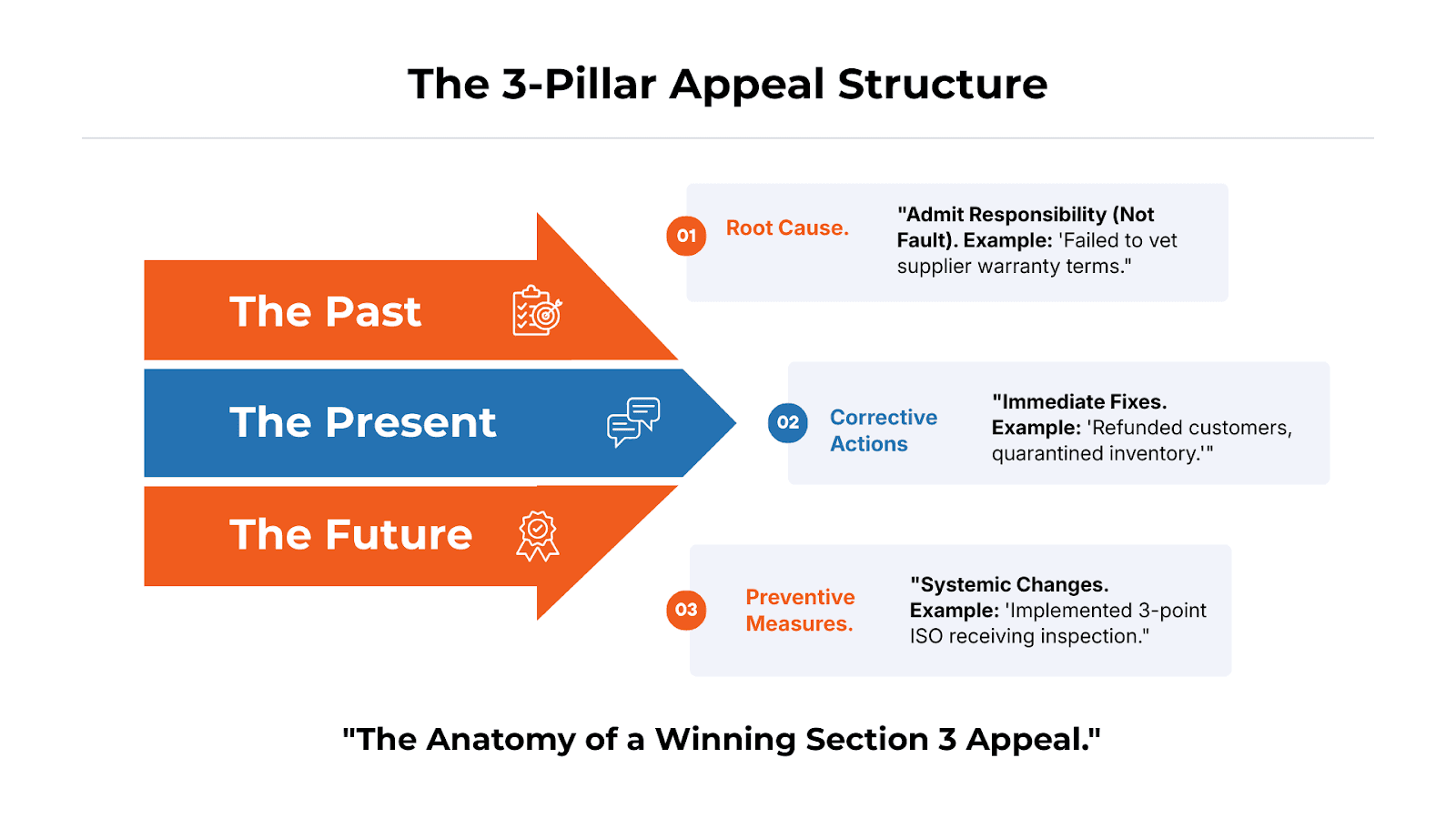
A professional POA has three distinct sections. It should not be emotional. It must be factual.
1. Root Cause (The "Why"): You must admit fault, even if it wasn't intentional.
2. Corrective Actions (The "Now"): What have you already done?
3. Preventive Measures (The "Future"): How can Amazon trust you won't do this again?
If you’re looking for a detailed, practical walkthrough on writing a strong POA, check out Amazon Seller Account Suspended? The Ultimate Reinstatement Guide.
4. Why Most Counterfeit Appeals Fail (Common Mistakes)
Mike’s first draft was full of excuses. He blamed the carrier for damaging boxes. If he had sent that, he would have failed. Here is why most sellers get their Amazon seller account rejected:
The Psychology of the POA: Being defensive. Amazon doesn't care whose "fault" it is; they care who is responsible. You are the seller; you are responsible.
Generic Templates: Mike almost bought a "$20 Guaranteed Appeal Template" online. These are death traps. Amazon’s AI recognizes boilerplate text. If your appeal resembles 10,000 others, it will be auto-rejected.
Vague Preventive Measures: Saying "I will try harder" means nothing. Saying "I have hired a Quality Control Manager" means something.
5. Recovering Inventory and Funds (If Reinstatement Fails)
What if the worst happens? What if Amazon refuses to reinstate the account?
For Mike, this was the $45,000 question. Even if he couldn't sell on Amazon anymore, he couldn't afford to lose that capital.
Recovering FBA Inventory
If the account remains banned, you must file a separate appeal specifically for Inventory Removal. You must argue that while Amazon may not allow you to sell the goods, the goods are your property and not counterfeit. This often requires a legal opinion letter.
Can You Recover Funds After a Counterfeit Suspension?
Amazon’s "Funds Disbursement" policy allows it to hold money indefinitely if it suspects fraud.
The Appeal: After 90 days, you can email the disbursement-appeals queue.
The Nuclear Option (Arbitration): If Amazon ignores the disbursement request, the final step is filing for Arbitration with the American Arbitration Association (AAA). This takes it out of Amazon’s hands and puts it before a neutral judge. It is expensive and slow, but for high-volume sellers like Mike, it is often the only way to recover six-figure payouts.
6. Should You Hire Help for a Counterfeit Suspension?
Mike sat with his cursor hovering over the "Submit" button on his Plan of Action. He had spent 48 hours drafting it. He had the invoices. He had the Root Cause. But a nagging thought stopped him: What if I missed one word?
He did the math. His business generates roughly $4,100 in sales per day. Every day he remains suspended, he loses that revenue forever. If his DIY appeal gets rejected and pushes the timeline back another week, that’s a $28,000 loss.
DIY vs. Professional Support
For a minor notification (like a Listing Policy Violation), a DIY approach is often fine. But a Section 3 Counterfeit Suspension is not a minor notification; it is a legal threat.
DIY Risk: If you submit a weak appeal, Amazon moves you to the bottom of the pile. Repeated failures can lead to the "We may not reply to further emails" notification—the final nail in the coffin.
Professional Support: An expert knows exactly what the internal investigator is looking for. They don't guess; they execute a formula.
The Service Landscape: Who Can You Trust?
Mike looked at the options, and the market was confusing:
The "Ex-Amazon" Consultant: Often a single freelancer. They have knowledge, but they lack the infrastructure to handle complex, multi-ASIN cases.
The Generic "Appeal Agency": These are often "factories" using the same templates for everyone. They are cheap, but dangerous for Section 3 cases.
The Law Firm: Necessary for Arbitration or if you are accused of criminal fraud. However, they are extremely expensive ($500+/hour) and often too slow for the pace of Amazon commerce.
This is where the ave7LIFT changes the equation. We are not just a software tool; we are backed by Avenue7Media, a full-service agency managing millions in GMV. When you click "Fix It," you aren't getting a freelancer; you are getting a team that has reinstated over 1,000 accounts. We combine the speed of AI diagnosis with the precision of human experts who speak "Amazon Legal."
Cost vs. Benefit Analysis
Mike realized that paying for an expert was not an "expense"—it was an investment in stopping the bleeding. If an expert costs $2,000 but gets him back online 5 days faster, he has saved $20,000 in lost revenue.
7. How to Prevent Future Counterfeit Suspensions
Mike eventually submitted a professional appeal (after having it reviewed by an expert) and was reinstated 72 hours later. The funds were released. The inventory was unlocked.
But Mike never wanted to feel that panic again or find his seller account suspended Amazon style ever again. He realized that "Defense Wins Championships." He needed to change his operations to ensure his Presence was bulletproof.
Supplier Vetting Checklist
To avoid the "Materially Different" trap, Mike implemented a strict vetting protocol for new vendors:
The "Authorized" Check: Do not just ask if they sell the brand; ask for their Letter of Authorization from the manufacturer.
The Google Maps Test: Look up the supplier’s warehouse address. Is it a legitimate distribution center, or a residential house?
The Sample Buy: Purchase one unit to test before placing a bulk order. Inspect the packaging. Does it match the Amazon detail page exactly?
Transitioning Business Models
Mike stopped dabbling in "Online Arbitrage" (buying from other retailers to resell). The margins were okay, but the risk of a Chain of Custody break was too high. He shifted 100% of his focus to wholesale relationships where he could get valid Commercial Invoices every time.
Invoice Standards
He standardized his paperwork. Now, every invoice must have:
Supplier Name, Address, and Phone Number.
Mike’s Company Name and Address (matching Seller Central perfectly).
Itemized SKUs and Quantities.
"Paid in Full" status (no pro-formas).
You can’t manually check every listing for "Counterfeit" trigger words every day. ave7LIFT acts as your 24/7 security guard. We monitor your Account Health and listing metadata, alerting you the moment a risk signal appears—so you can fix it before the suspension notice arrives.

Conclusion
A counterfeit suspension is not a routine Amazon setback—it is a direct threat to your entire business. Section 3 enforcement is designed to protect Amazon, not sellers, and it operates on a ruthless “guilty until proven innocent” model. Funds are frozen, inventory is locked, and one poorly written appeal can permanently end years of work. As this guide makes clear, most sellers are suspended because their documentation, chain of custody, or response fails to meet Amazon’s legal standard.
Winning reinstatement requires precision, not panic: verified commercial invoices, clear authorization, and a carefully structured Plan of Action that speaks Amazon’s internal legal language.
This is where ave7LIFT becomes essential. ave7LIFT isn’t a template or a generic appeal service—it’s a 24/7 defense system for Amazon sellers. It monitors account health, Voice of Customer data, and policy risk indicators in real-time, alerting you before a counterfeit suspension occurs. And when enforcement does happen, ave7LIFT connects you directly to human experts who know how to navigate Section 3 and recover accounts, inventory, and funds.
Summary
An Amazon seller account suspended for counterfeit in the USA is one of the most severe enforcement actions Amazon can take. Triggered under Section 3 of the Business Solutions Agreement, it operates on a “guilty until proven innocent” model, immediately deactivating the account, freezing funds, and locking FBA inventory, which is at risk of destruction. Crucially, these suspensions are not limited to fake products—genuine items can be labeled “counterfeit” if Amazon cannot verify the chain of custody, invoices, authorization, or if products are deemed materially different, such as lacking a valid warranty.
This guide explains how counterfeit suspensions are triggered, the difference between Amazon’s definition and legal counterfeiting, and why most appeals fail. It walks sellers through evidence requirements, invoice standards, Plan of Action strategy, inventory and funds recovery, and when professional help is critical. Ultimately, the key to reinstatement—and future protection—lies in airtight documentation, disciplined supplier vetting, and proactive monitoring to stop risks before Amazon’s bots shut your business down.
Frequently Asked Questions
More Insights from us