All blog
Suspensions
Dec 12, 2025
6 Min read

Account Suspension
Amazon Seller Account Closed Vs. Suspended: Is It Permanent?
With Amazon facing a $30 million lawsuit, sellers are in the spotlight. Discover why protecting your account and inventory is more critical than ever.
TL;DR
An Amazon seller account closed is temporary, allowing limited dashboard access, POA submissions, and the chance to restore listings, funds, and selling privileges. In contrast, a closed Amazon seller account is permanent—access is fully revoked, sub-users and API keys are removed, funds become high-risk, and appeals are typically rejected. While suspensions can often be reversed with strong documentation and evidence-backed appeals, closures are rarely recoverable except through rare legal arbitration paths.
Did Amazon Close Your Seller Account – Or Just Suspend It?
In the high-stakes emergency room of e-commerce, specific legal terms like Suspended, Deactivated, Closed, or Banned dictate your survival chances. When Amazon locks you out, the exact wording of the notification matters most.
Far too many sellers see a blocked screen and immediately assume their ‘Amazon seller account closed’ status is final, leading them to give up on a recoverable asset.
This misunderstanding is often more damaging than the ban itself, a reality that nearly destroyed Alex’s business. Alex, a successful Private Label seller in the Sports & Outdoors category, saw a notification stating, “Your access to Seller Central has been terminated.” Panic set in immediately. He told his business partner that their account was "Closed" and the business was dead.
He was wrong. In reality, Alex was merely “Deactivated”—a standard, temporarily suspended Amazon account state. While preparing documents for a closure that never happened, he let dozens of orders expire. The resulting late shipment rate violation added to the ongoing crisis.
We’ve seen dozens of sellers make the same mistake. One ave7LIFT user shared: “I assumed the worst and froze all warehouse ops. That mistake hurt more than the suspension itself.”
This reinforces the same lesson Alex learned — misdiagnosis creates damage Amazon never intended. If you don’t know which bucket you fall into, you cannot apply the right cure.
The following guide acts as your Status Explainer Hub for suspended vs closed Amazon seller accounts. We will walk you through the true permanence of a closed account, the legal paths for asset recovery, and how to manage pending orders—so you don’t make the same mistake Alex did.
Don’t turn a fixable suspension into a closure. Get a30 Day free trial from ave7LIFT diagnosis and know the exact next step—appeal or attorney.
1. Amazon Account Suspended vs Closed — The Core Differences
The confusion that led Alex to misdiagnose his status stems from one simple fact: Amazon’s "Deactivated" screen looks terrifyingly final. However, legally, a suspension and a closure are worlds apart. One is a pause button; the other is an eject button.
To avoid making the same tactical error, you must understand what they mean.
What Is an Amazon Seller Account Suspension?
Before you can respond correctly, you need to understand what Amazon classifies as a suspension.
It’s a temporary loss of selling privileges caused by:
Policy violations
IP complaints
Performance issues
Invoice verification failures
Abnormal login or payment activity
Key traits of a suspension:
|
When you see an appeal button or POA request, refer to “Amazon Seller Account Suspended” for the step-by-step reinstatement method.
What Does “Amazon Seller Account Closed” Actually Mean?
An Amazon seller account closed is a status that leaves no room for recovery. This status is essentially permanent. The account is fully dissolved, with only rare legal arbitration offering a chance to challenge the closure.
Three ways an account closes are:
Voluntary Closure: This is when you closed the account manually. By doing so, it’s you who is requesting a formal Amazon seller account cancellation.
Amazon-Initiated Closure: Occurs due to inactivity, expired documents, or severe violations.
Permanent Ban for fraud or prohibited behaviour.
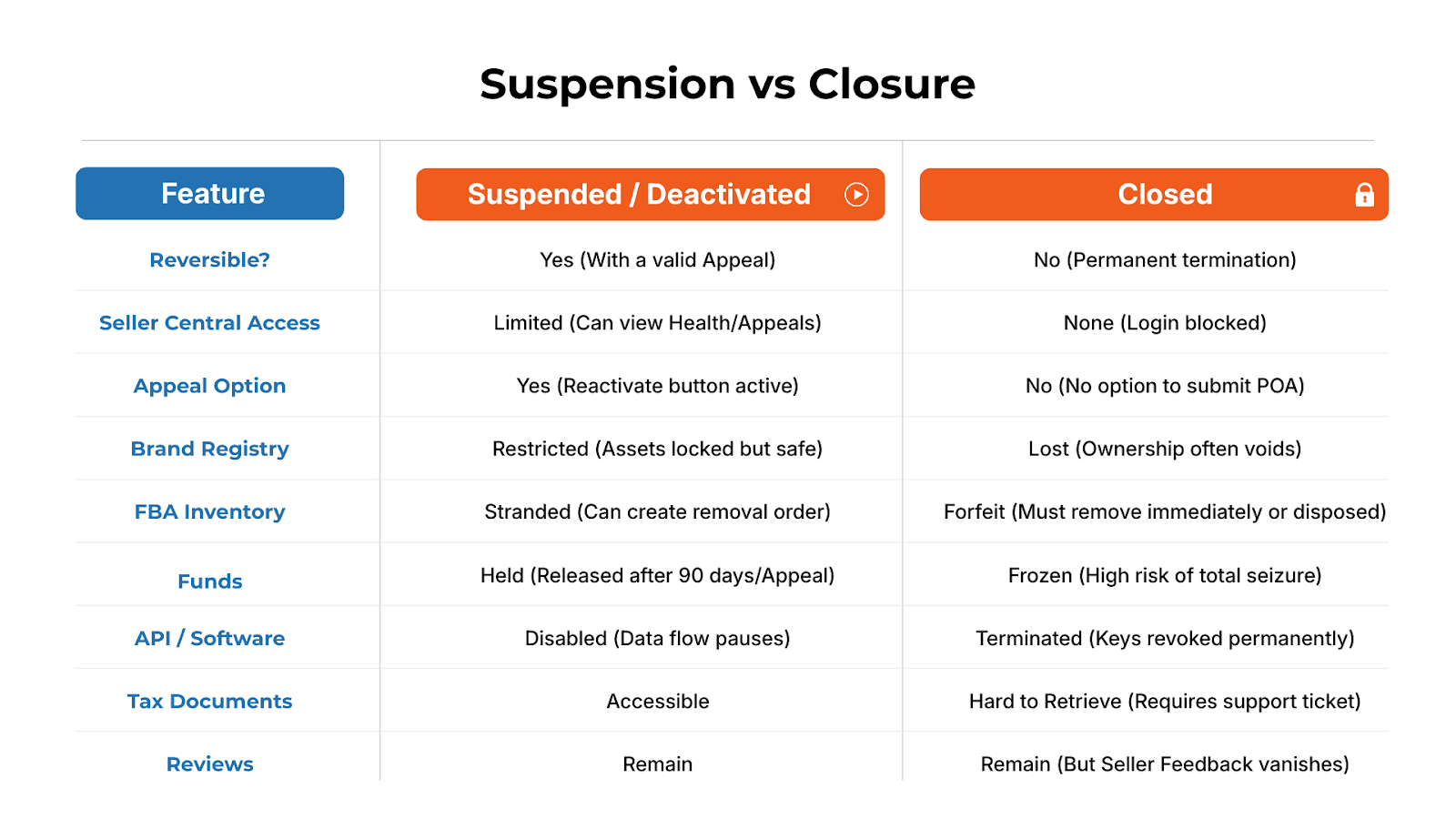
Differences Between Account Suspension and Closure
If you’re unsure whether you’re dealing with a suspension or a fully closed Amazon seller account, use the table below to identify your exact account status.
2. Impact of Account Status on Amazon Global Selling Markets
Regional Isolation vs Global Block
One of the first questions Alex asked us was, “If my US account goes down, is my UK account safe?” The answer: No.
He assumed each marketplace was independent because they operate under different laws. But Amazon uses a unified global account identity, where all regions share the same backend trust score.
When one marketplace flags your entity as a risk, Amazon’s system triggers what we call Cross-Border Contagion—a chain reaction that spreads to every linked region, causing simultaneous Amazon account suspensions across marketplaces.
What Cross-Border Contagion Looks Like
Once your entity is flagged, Amazon’s global risk engine can trigger several system-wide actions across your entire selling network:
Duplicate Document Requests: You may be asked to re-verify your identity or business documents in all regions simultaneously, even previously approved ones.
Payment Holds: Balances across multiple currencies can be placed on hold while Amazon re-evaluates your operational risk and chargeback exposure.
Listing Creation Block: You cannot create new ASINs anywhere until the underlying suspended Amazon seller account issue is resolved.
Therefore, "Cross-Border Contagion" isn't about geography; it's about entity risk. Because Amazon links your accounts globally, a violation in one region instantly triggers suspensions across your entire network.
Closing One Marketplace vs. Closing the Entire Account
You may voluntarily close your Amazon.ca, Amazon.co.uk, or Amazon.de seller accounts — a normal process often referred to as closing your Amazon seller account or Amazon seller account cancellation — while still keeping your main US store active.
However, if Amazon initiates the action and marks your profile as an Amazon seller account closed status (instead of a simple cancellation), this is no longer regional. When Amazon closes the entire selling account, all linked marketplaces are affected, and everything shuts down globally.
Treat your US Amazon seller account as the anchor for all other regions; when something goes wrong there, assume your entire global catalogue and cash flow are at risk, not just one marketplace.

3. Amazon Brand Registry Benefits — Suspended vs Closed
Asset Protection During Suspension
Before you worry about losing your brand assets, here’s what actually stays protected during a suspension.
A+ Content visibility
Brand Registry ownership
Listing protection
But access is restricted — you cannot make updates or submit new brand edits until the suspension is lifted. This is very different from an Amazon seller account closed status, where Brand Registry becomes permanently locked.
Can You Transfer Brand Registry After Closing an Account?
Yes, it is possible, but it is tough. Amazon often requires:
Notarized trademark transfer
Proof of ownership
Full verification from the receiving account
When the case involves an Amazon seller account closed due to policy violations or a ban, transfer attempts often fail because Amazon treats the locked Brand Registry as part of the closed entity.
4. Handling Pending Orders During Suspension vs Closure
Fulfillment Obligations
This is the moment when Alex nearly destroyed his business. When he saw the "Deactivated" notice, he told his warehouse manager, "Stop packing. We are shut down."
This was a critical mistake.
Alex had 45 pending FBM (Fulfilled by Merchant) orders sitting in the queue. By halting fulfillment during an Amazon account suspension, he walked straight into a trap. Even with a suspended Amazon account, your customer obligations continue despite Amazon putting your account “on a break.”
If You Are Suspended: You MUST ship every single pending order. You still have access to the "Manage Orders" page. If you fail to ship these, you will trigger a "Late Shipment Rate" violation on top of your existing suspension, making your Amazon account suspended appeal much harder to win.
If You Are Closed: The decision is taken out of your hands. You cannot access customer addresses or confirm shipments. Amazon will cancel all pending orders and issue automatic refunds to the buyers at your expense.
Handling Returns and Refunds Without Account Access
When you have a suspended Amazon account, you still retain limited access to the Returns dashboard. It’s slower and inconvenient, but you must continue processing returns to prevent claims from piling up.
Once an account is closed, you lose all control—Amazon auto-approves refunds, you can’t dispute them, request returns, or file SAFE-T claims. In short, you lose both your money and your inventory.

5. Third-Party Software & API Integrations During Downtime
API Token Revocation
Amazon safeguards its data strictly. When suspended, API connections are temporarily disabled, causing tools (such as Helium 10 or Jungle Scout) to display errors.
However, when dealing with a closed Amazon account, API keys are permanently terminated. Regaining access usually requires creating a new entity and re-authorizing every app from scratch.
Disconnecting Apps Before Closing an Account
If you are voluntarily closing your Amazon seller account to leave the platform, don’t just walk away. Your software subscriptions will keep billing you even if they can't talk to Amazon. Since these external tools operate independently of Seller Central, you must execute a complete digital disconnection to ensure no "phantom charges" hit your credit card months later.
To ensure you leave with no loose ends, follow the "Clean Break" Checklist below:
Revoke API Keys: Go to Settings > User Permissions > Third-Party Developer and Apps and remove access.
Cancel SaaS Subscriptions: Manually cancel your repricers and inventory tools. They do not know you initiated an Amazon seller account cancellation.
Disconnect Inventory Feeds: If you use a tool like Shopify or ChannelAdvisor, sever the link to prevent it from trying to push stock to a dead Amazon account.
6. Tax Reporting & Document Access
One of the most dangerous misconceptions sellers have is that if Amazon shuts them down, their tax obligations disappear. This is false. Whether you are suspended or closed, the IRS (or your local tax authority) still expects a 1099-K form and a clean Profit & Loss statement.
However, your ability to access these critical documents depends entirely on your account status.
Loss of Historical Data After Closure
This is the "Digital Blackout."
Suspended: If you have a suspended Amazon account, partial access survives. Amazon restricts your ability to sell, but they usually leave the "back office" open so you can resolve financial issues.
Closed: When an Amazon seller account's closed status is finalized, retrieval becomes difficult and inconsistent. You lose access to the Tax Document Library and years of transaction history. If you are audited later, you will not be able to log in to download the proof you need.
Generating Sales Reports While Suspended
If you are merely suspended, you are in a safer position. Despite the suspension, Amazon typically allows access to:
Payments Dashboard: To monitor held funds.
Date Range Reports: Essential for reconciling your books.
Tax Document Library: Where your 1099-K lives.
Pro Tip: Download these immediately. You’ll need them for tax season and to support your Amazon account suspension appeal by proving legitimate sales velocity. Read Preparing Your Appeal & Plan of Action (POA) to see how these records strengthen your reinstatement case.
Opening a new account incorrectly will trigger an instant "Related Account" ban. Sign up to ave7LIFT and get an AI-powered account scan to check your new entity setup before you apply, reducing the risk of linking back to your closed account.
How To Get 1099-K From a Closed Amazon Account (H3)
If you finalized the process of closing Amazon seller account operations (or were banned) before downloading your tax forms, you are locked out of the automated system. You cannot log in to fetch your 1099-K.
To recover this document, you must go through a manual verification process:
Contact Tax Operations: You must send a formal request to Amazon’s tax support email, typically tax-ops-support@amazon.com (as of this writing).
Submit Verification: They will require proof of identity (EIN/SSN matching the closed account) to release the data.
The Waiting Game: Unlike the instant download in Seller Central, this manual retrieval process can take 15–45 days.
7. Legal Recourse & Arbitration Pathways
If standard appeals fail, or if Amazon is holding your funds illegitimately, you move from "Seller Performance" (Amazon’s internal enforcement team) to "Legal." However, the effectiveness of a lawyer depends entirely on your status.
When “Permanent” Isn’t Final
When Amazon enforces a suspension or ban, you still have rights. "Permanent" in Amazon's emails often just means "Seller Support can no longer help you."
You can escalate via:
Attorney Demand Letters: Formal notice to Amazon’s legal department.
Executive Seller Relations: Escalating to the Jeff/Executive team.
Arbitration (Section 18): The “Nuclear Option” for suspended Amazon seller account disputes.
Amazon Section 18 — Demand for Arbitration
Under Section 18 of the Business Solutions Agreement, you can demand arbitration to challenge an Amazon seller account suspended status or frozen funds.
Appeals agencies are built to craft and refine your POA, while an Amazon account suspended lawyer can push into formal disputes and arbitration; knowing which one you need depends on how serious the allegations and frozen funds are.
Important Note: Unlike an enforced ban, voluntarily closing an Amazon seller account cannot be reversed by a lawyer. No amount of legal pressure can force Amazon to reopen a contract you willingly ended via the Amazon seller account cancellation button.
8. User Permissions & Sub-Account Access
Employee/VA Access
Your account status affects team access. When suspended, sub-user permissions are limited. Most VAs lose access to inventory, but can still help with the Amazon account suspension appeal if they have "Performance" or "Case Log" rights.
In contrast, when closed, all sub-account access is revoked, and VAs cannot log in or communicate with Seller Support.
Revoking User Access Before Closure
Before voluntarily performing an Amazon seller account "Close Account" action, clean all users and app connections to avoid triggering “Related Account” flags tied to shared employee emails.
Do the following first:
Delete VA Accounts: Go to Settings > User Permissions and remove all secondary users.
Revoke Developer Access: Remove all third-party app authorizations.
Disconnect APIs: Ensure no external software is still pinging the account.

Concusion
So, back to the question Alex asked us on that frantic phone call: "Is my business dead?"
The outcome depends entirely on the word Amazon shows on your screen. A suspended Amazon account is not permanent—it’s a temporary pause, not a deletion. Meanwhile, an Amazon seller account closed status is effectively permanent.
If you’re staring at a blocked screen, use these simple decision points:
If You Are Suspended:
Do not wait—every hour down is lost revenue.
Your next step is to craft a proper Amazon account suspended appeal, not guesswork.
If You Are “Closed” (Enforced):
If you committed fraud or ignored repeated warnings, reinstatement is unlikely.
Stop focusing on getting the account back—shift your attention to recovering your frozen funds.
Begin preparing for a formal legal demand or arbitration.
If You Are Looking at an Amazon Seller Account Cancellation:
Ensure you have downloaded all tax reports and disconnected APIs before you finalize the Amazon seller account “Close Account” steps.
Summary
1. The Core Difference
Suspended: Temporary and reversible. You retain partial backend access, and funds are held. Reinstatement is possible via a data-backed appeal.
Closed: Permanent and irreversible. You lose all access (including invoices/tax docs), and assets are deleted. Reinstatement is rare.
2. Operations & Assets
During Downtime: Suspended sellers must fulfill pending orders to avoid further violations. Closed accounts have orders automatically cancelled/refunded by Amazon.
Assets: Suspensions suppress listings but keep Brand Registry active. Closures delete listings and revoke Brand Registry.
Global Impact: A suspension in one region often locks accounts globally.
3. Action Plan
Voluntary Closure: Always download data and disconnect third-party apps before closing.
Recovery: For suspensions, appeal immediately with root-cause analysis. For closures, focus on recovering funds through legal arbitration (Section 18), as account restoration is unlikely.
Frequently Asked Questions
More Insights from us